About Christine Downloads Writing Chapters Get Updates
Available Now · 2026

The
Alignment
Economy

Rebuilding the Connection Between Effort and Stability

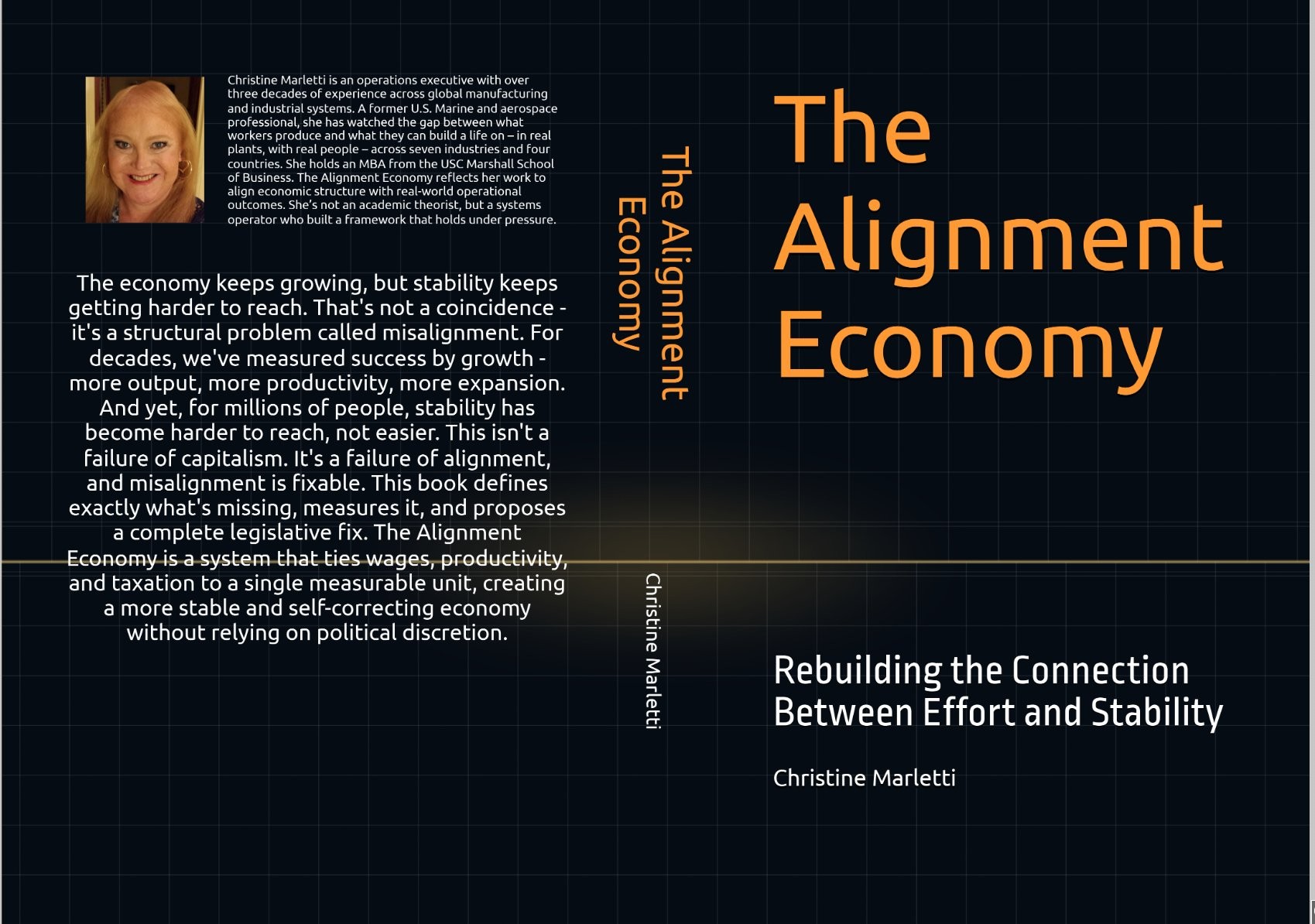
The economy keeps growing, but stability keeps getting harder to reach. That's not a coincidence — it's a structural problem called misalignment. This book defines exactly what's missing, measures it, and proposes a complete, implementable fix.

Christine Marletti
Christine Marletti
Operations Executive · U.S. Marine · MBA, USC Marshall
The Alignment Economy — full book cover
ISBN 979-8-9959221-0-0 Paperback
ISBN 979-8-9959221-1-7 Hardcover
Christine Marletti
Christine Marletti
Author

Christine Marletti is an operations executive with over three decades of experience across global manufacturing and industrial systems. A former U.S. Marine and aerospace professional, she has watched the gap between what workers produce and what they can build a life on — in real plants, with real people — across seven industries and four countries.

She holds an MBA from the USC Marshall School of Business. The Alignment Economy reflects her work to align economic structure with real-world operational outcomes. She's not an academic theorist, but a systems operator who built a framework that holds under pressure.

30+ Years Operations U.S. Marine Aerospace 7 Industries 4 Countries MBA · USC Marshall

"This isn't a failure of capitalism. It's a failure of alignment — and misalignment is fixable. This book defines exactly what's missing, measures it, and proposes a complete legislative fix: a system that ties wages, productivity, and taxation to a single measurable unit, creating a more stable and self-correcting economy without relying on political discretion."

01
New Here?
Start with Christine's story — why this book exists and who it's for.
Read the Author's Note →
02
Want the Framework?
Download the Technical Appendix and Legislative Framework — free.
Get the Documents →
03
Following the Argument?
Essays, Substack posts, and deeper dives into alignment economics.
Read the Writing →
04
Want to Stay Close?
New chapters, essays, and updates directly to your inbox.
Subscribe →
Christine Marletti
Operations Executive — 30+ years
U.S. Marine · Aerospace background
7 industries · 4 countries
MBA, USC Marshall School of Business
Author's Note

Why This Book Exists

Christine Marletti

I grew up poor. Not the kind of poor that gets romanticized in retrospect — the kind where your school clothes come from Goodwill and you eat meals like goulash or chili surprise, because your parents are quietly stretching whatever is left. You don't recognize it as poverty when you're living it. You recognize it later, when you understand what your parents were doing and why.

My father was a Teamster who drove a truck for forty-two years. My sisters built lives with their hands and their persistence. None of them lacked effort. None of them lacked diligence. What the system lacked was any mechanism to translate that effort into stability — and over time, despite everything they did right, the distance between what they earned and what things cost kept growing.

"The difference between us was not effort. It was circumstance — the kind of circumstance that our current system was never designed to account for."

I have been incredibly fortunate. I went to school while working full time, pushed as hard as I could for as long as it took, and found a position in this economy where I am not behind. I am aware of what that cost and I am aware that others who worked just as hard did not end up where I did.

There is a saying I have carried for years: if you finally make it to the top, the least you can do is send the elevator back down. That is what this book is. It is not a policy paper written from a distance. It is an attempt by someone who felt the weight of that shame — the public assistance, the thrift store clothes, the careful silences around money — to build something that might prevent the next family from feeling it too.

Regardless of title or position, we are all one unfortunate set of circumstances away from being left behind. I think about this often. This work exists because I have not forgotten that.


Order the Book Get Free Downloads
Free Resources

The Full Framework,
Available to Everyone

The book makes the argument. These documents provide the complete technical and legislative architecture behind it. Download free — just leave your email so we can send you updates as the work evolves.

Technical Appendix
Technical Appendix
The complete mathematical and operational specification of the National Productivity Unit — the NPU formula, alpha/beta constraint logic, EEBV calculation methodology, and the full Stability Fund mechanics.
NPU Formula EEBV Methodology Stability Fund Worked Examples
Legislative Framework
A complete legislative architecture structured for implementation within existing institutional systems — covering the transition model, corporate participation mechanisms, offshore capital integration, and governance constraints.
Transition Model Governance Corporate Rules Partisanship Defense
Media & Press
Press & Media Kit
Author bio, high-resolution cover images, key quotes, chapter summaries, and talking points for podcasts, interviews, and editorial coverage.
Author Bio Cover Images Key Quotes Talking Points
From the Author

Essays & Writing

Follow on Substack
I Don't Know What Happened to Ronnie — But I Know What Happened to the System
I wrote a few days ago about Ronnie. Not a famous Ronnie. Not a childhood best friend. Just a guy I worked with more than thirty years ago. The more I've thought about Ronnie, the more I've realized this isn't really a story about him. It's a story about what quietly changed around all of us.
Read the Essay →
What Is a National Productivity Unit — And Why Does It Matter?
Right now, everything in the economy is measured in dollars. The problem is that the meaning of a dollar changes constantly. The NPU is a different kind of unit — one measured against real output.
Read →
What Alignment Actually Looks Like When It Works
I'm not sure I knew what "the alignment economy" meant when I first started using the phrase. So I stopped explaining it that way. Instead I tell people about Ronnie.
Read →
Your Paycheck and the Cost of Living Are Supposed to Move Together. They Don't.
That feeling — the one where you're doing everything right and still falling behind — isn't a personal failure. It's a structural one. Wages, costs, and taxes were never designed to move together. They drift. And you absorb the gap.
Read →
The Economy Is Not Broken. It's Misaligned. There's a Difference.
Most conversations about economic hardship start with blame. I want to offer a different frame. One I didn't learn from economics. I learned it from manufacturing.
Read →
What "The Alignment Economy" Is About
This is not a failure of effort. It is not a failure of capitalism. It is a failure of alignment. The book proposes a structural fix — a measurable standard that anchors wages, taxes, and economic scaling to real output.
Read →
Why Me? I Am Not an Economist. That's the Point.
I fix misaligned systems for a living. A few years ago I realized I had been looking at the same problem in two very different places — manufacturing floors and the broader economy. The gap is structural. It does not close until the structure changes.
Read →
Inside the Book

Thirteen Chapters.
One Complete Argument.

From diagnosis to mechanism to full implementation — a structural case for rebuilding alignment.

Foundation — Chapters 1–3
  • Ch. 1 The Original Promise of the System Foundation
  • Ch. 2 The Visible Cracks in the System Foundation
  • Ch. 3 The Missing Anchor Has a Shape Foundation
Architecture — Chapters 4–7
  • Ch. 4 From Understanding to Construction Architecture
  • Ch. 5 What Happens When the Economy Breaks Architecture
  • Ch. 6 Why Systems Don't Change (Even When They Should) Architecture
  • Ch. 7 Where Change Actually Starts Architecture
Scrutiny & Implementation — Chapters 8–13
  • Ch. 8 The Moment After Understanding Scrutiny
  • Ch. 9 The Moment the System Must Be Proven Scrutiny
  • Ch. 10 What This Looks Like in the Real System Implementation
  • Ch. 11 The First Day the System is Real Implementation
  • Ch. 12 The First Question Everyone Asks Implementation
  • Ch. 13 Why Systems Like This Don't Happen Easily Close
Order the Book
Stay in the Conversation

Effort should mean
more than it does.

That's not a complaint. It's a structural diagnosis — and there's a framework for fixing it. Subscribe for the argument, the mechanics, and the human stories behind both. Free. Twice a week.