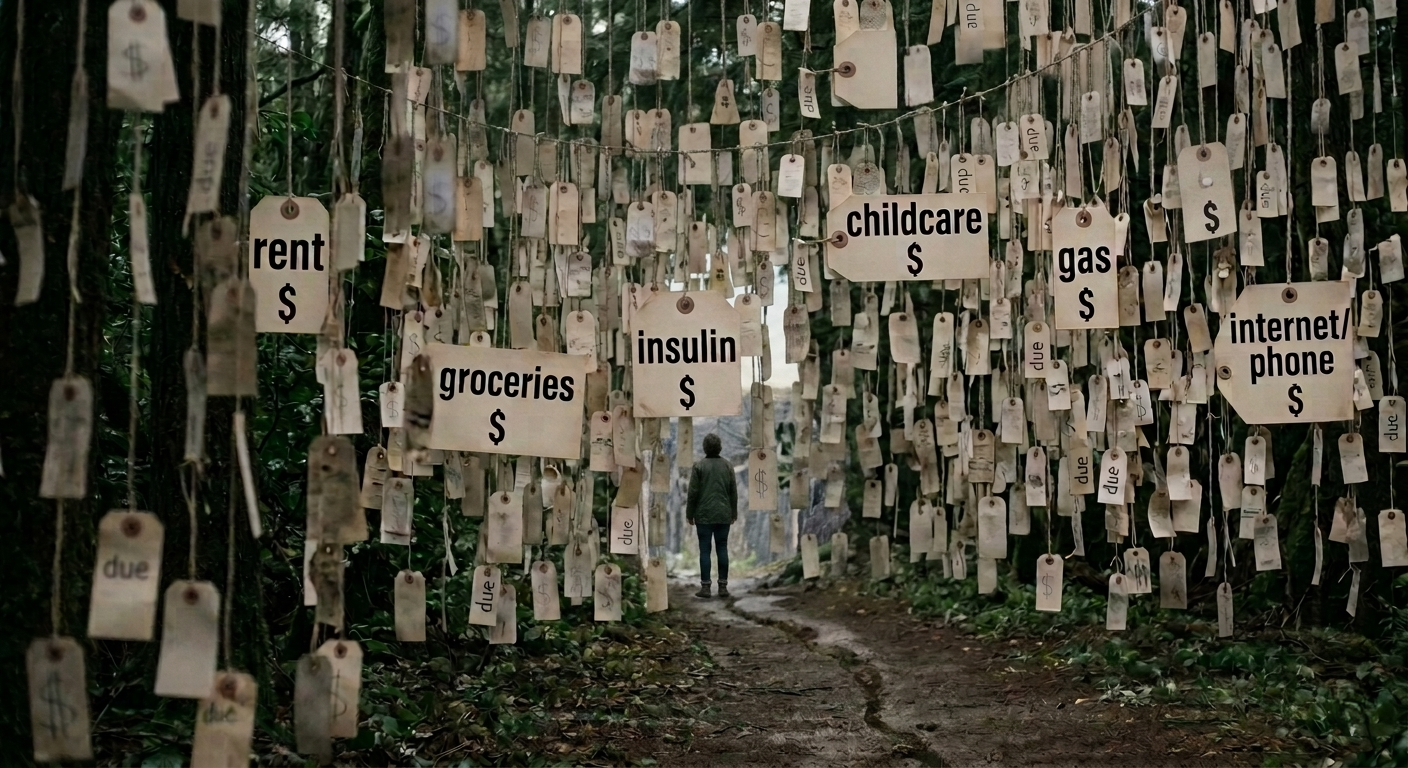
There’s a particular moment in getting lost in the woods when you realize the path is still under your feet. You didn’t leave it. You followed it. Every step was the right step, according to the path. And then the trees closed in on both sides, and now there’s a wall in front of you that wasn’t supposed to be there, and the only way out is to walk back the way you came.
That’s not a navigation failure. That’s a path that went the wrong direction.
The American economy has been walking a path like that for about fifty years.
The economy kept moving
This is what makes structural drift harder to diagnose than a crash. When something breaks, you feel it. The system stops. But drift doesn’t stop anything. GDP kept climbing. Productivity kept improving. The jobs reports kept printing positive numbers. The economy was moving — confidently, measurably, in a direction that looked like progress from every instrument we had.
The problem was where it was going.
Between 1983 and 2000, economists projected that average wages would grow about 24 percent. Actual average wage growth came in at 28 percent. That’s a good forecast. Close enough that the models looked right.
But wages for the top six percent of earners — the people who earn above the Social Security tax cap — grew 62 percent in that same period. And wages for the other 94 percent grew 17 percent.
The average was fine. The distribution had walked off in a different direction entirely.
By the time that shows up in the data people actually feel — rent, groceries, childcare, gas, a phone bill that doesn’t go down — it’s not a recent problem. It’s accumulated distance. The gap between what the economy produces and what most people can afford wasn’t created by a single policy or a single administration. It was built one year at a time, while the headline numbers looked fine.
Stagnation is the wrong word
There’s a tendency to describe this as stagnation. Wages stagnated. Mobility stagnated. The middle class stagnated. But stagnation means something stopped moving. Stagnant water just sits there.
That’s not what happened. The economy kept moving. The productivity gains were real. The output growth was real. What drifted was the relationship between what the economy produced and what most workers received for producing it.
Stagnation implies a system that ran out of energy. Drift implies a system that ran full speed in the wrong direction. Those require different fixes.
You can restart a stalled system. Add fuel, cut rates, inject stimulus. That works when the engine stopped.
When the path went wrong, the only way back is to retrace the distance. No shortcut through the trees. You account for how far you went, you turn around, and you walk.
The wall at the end of the path
For most working households, the wall isn’t abstract. It’s specific.
It’s the rent that went up faster than the raise. It’s the grocery bill that doesn’t respond to anything you do differently. It’s the insulin that costs what it costs because it costs what it costs. It’s the childcare bill that makes the math on working not work. It’s the gas and the phone and the utilities — the things you cannot cut because you cannot function without them.
None of those price tags appeared overnight. Each one moved a little, year after year, in a system where prices adjusted and wages didn’t have to. The wall built itself while the path kept going.
And here’s what makes it structurally interesting rather than just politically convenient: it’s not that someone built the wall to stop you. It grew. The same economy that generated enormous returns for capital at the top generated a cost-of-living wall for everyone else at the bottom. Both things happened inside the same system, governed by the same rules, producing the same GDP number.
What retracing actually means
Turning around in the woods is not a complicated decision. Executing it is. You have to walk back the same distance you walked in. There is no other option. The trees don’t move. The wall doesn’t move. You do.
In an economy, retracing means anchoring the things that drifted to something real. Not a policy aspiration, not a target range, not a guideline. A standard. Something that says: this is what an hour of productive work is worth in this economy, and wages, costs, and taxes will be calculated against it.
That’s the argument of The Alignment Economy. Not that the system is corrupt. Not that the people at the top stole it. But that the system has been running without a shared standard for long enough that the distance between what it produces and what most people experience has become structural. And structural problems don’t respond to targeted interventions. They respond to redesign.
The National Productivity Unit is a proposed standard. An anchor. A way to stop the drift from being possible in the first place — because everything ties back to the same measurement of what the economy is actually producing, per person, per hour.
The path is still under your feet. You just have to turn around.